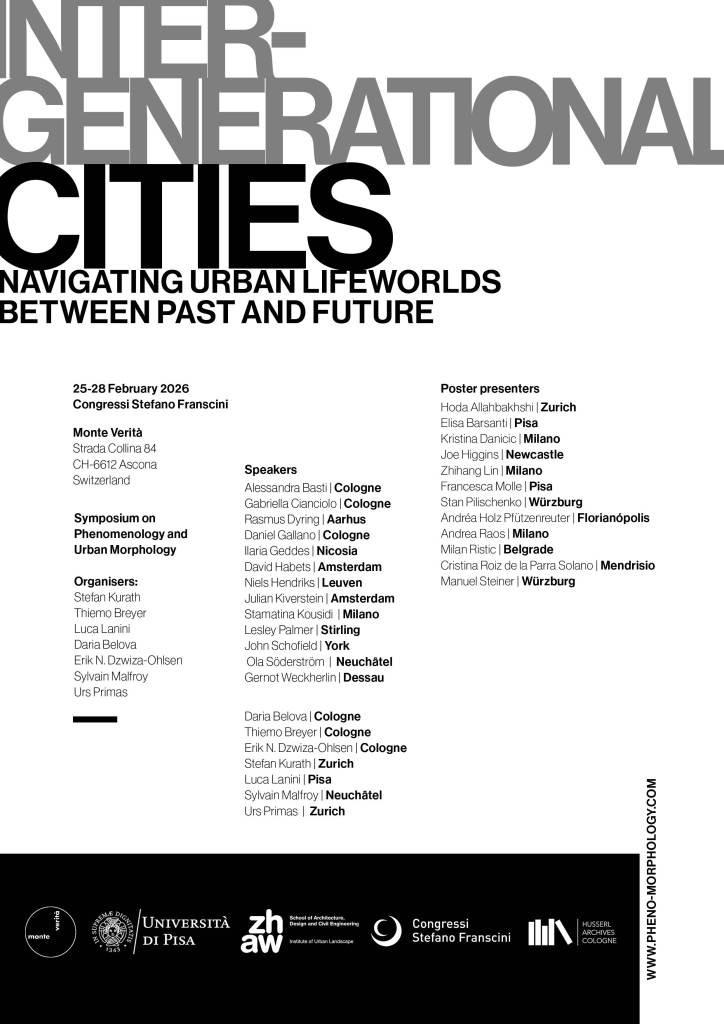
Conference at Monte Verita, Ascona, 25. – 28. February 2026
The symposium explores urban environments through the lens of intergenerationality. It addresses how people of all ages and abilities experience, navigate and co-create the spatial and cultural fabric of the city. Moving beyond isolated age-focused designs, we bring together diverse perspectives to shape more inclusive, walkable and sustainable urban futures.
The intergenerational city emerges as a topical challenge as cities need to shift paradigms towards accessible, walkable and easily navigable neighborhoods. The urbanization of the past century has left us with increasingly complex and technology-laden environments and was relying on an unsustainable growth in mobility. Geared towards able and technologically skillful adults, the city of transportation impaired and even excluded many others. In contrast, the intergenerational city of the future will need to be accessible, understandable and safe for everybody – including children, youth, the elderly or people with impaired bodily or cognitive abilities. So far, much of the research on sustainability, smart growth or walkable neighborhoods has centered on the needs of a selected demographic segment such as the elderly. In contrast, the Intergenerational City considers the needs of all age groups and ability profiles. Furthermore, current approaches tend to focus either on global indicators of sustainability and inclusiveness, or on the micro-scale of projects for intergenerational buildings, leaving aside crucial practical questions at the meso-scale of neighborhood planning and urban design.
This transdisciplinary workshop addresses the challenge of connecting our knowledge of the spatial structure and history of urban environments to insights on how humans of all age groups and skill sets experience and navigate their everyday lifeworld. While planning disciplines such as urban design and architecture have accumulated operational knowledge on the historical formation, present structure and future potentials of urban environments, fields such as phenomenology, embodied cognition or ecological psychology have investigated the structure and properties of lived human experience. These two strands of research have established similar and overlapping concepts, centering around notions such as “place”, “situation” or “type” and taking a processual view on the historical evolution of interrelations between habituality and spatial structure. Until recently, this important potential of common ground regarding our understanding of intergenerational environments has remained largely unexplored. This symposium addresses the resulting gap between research and practice by bringing together theorists and practitioners from the fields of urban morphology, heritage studies, applied phenomenology, embodied cognition, ecological psychology and affordance theory with protagonists of neighborhood and community projects as well as urban planners and architects involved in the conception of inclusive and sustainable intergenerational environments.
The three-day symposium forms part of the renowned international Congressi Stefano Franscini series and takes place at Monte Verita, a wonderful venue with a rich history of scientific and cultural exchange, situated high above Ascona and the Lago Maggiore.
Read more:
 Phenomenology & Urban Morphology