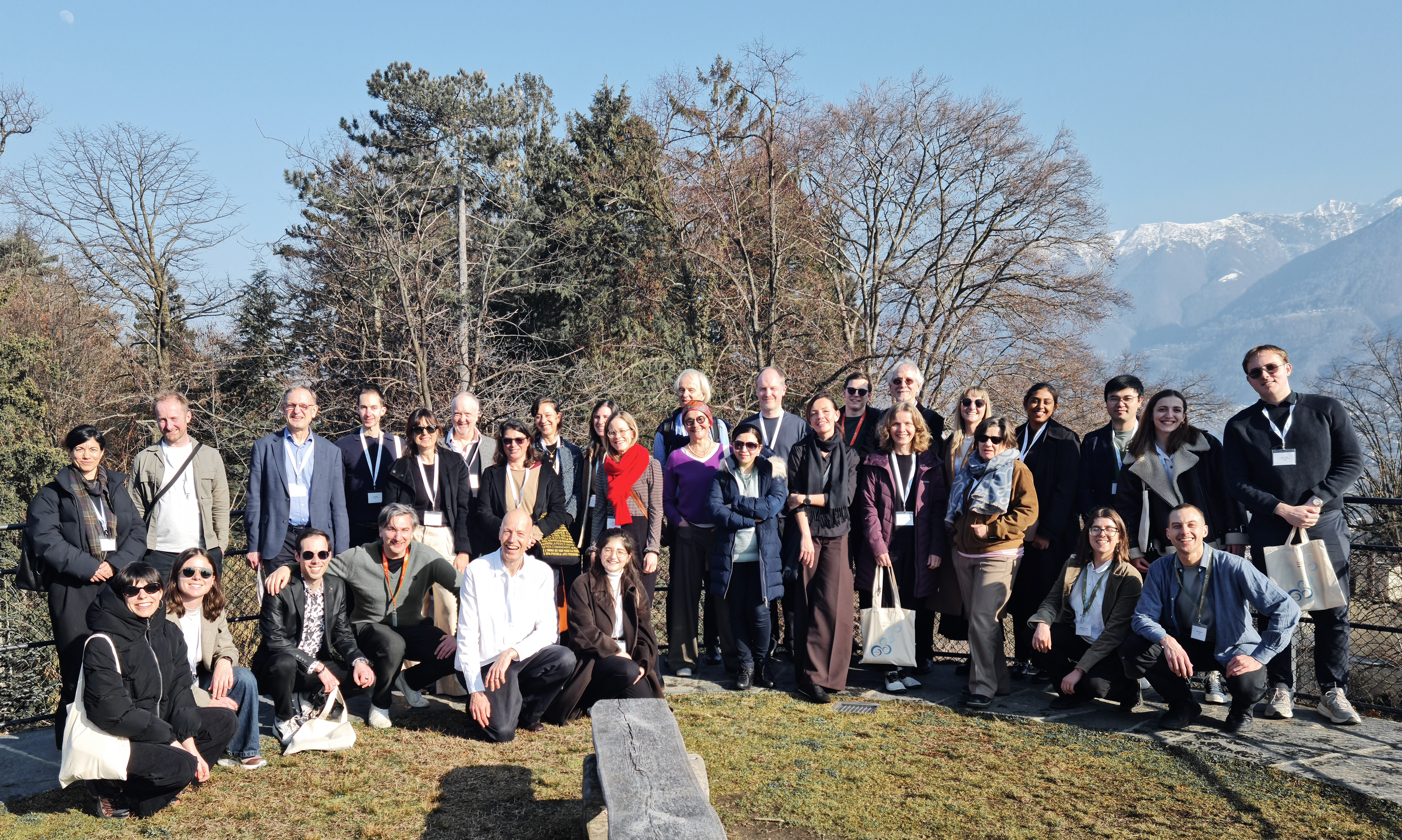
Online workshop on 20/11/2026: follow-up to conference at Monte Verità, Ascona.
To register please follow the instructions below
coming soon
Participants
Alessandra Basti | Cologne
‘Atmospheric Legacies: A New-Phenomenological Study of Intergenerational Memory in Cologne’s Aachener Berg and Kalkberg’
Alessandra Basti is a doctoral researcher at the a.r.t.e.s. Graduate School for the Humanities at the University of Cologne and is affiliated with the Husserl Archive in Cologne. She also holds a co-tutelle agreement with the University of Turin. She completed her MA in Philosophy at the University of Turin and the Friedrich Schiller Universität Jena, where she developed a tentative phenomenological approach to literature through her thesis. Her current research focuses on phenomenological aesthetics, with a particular emphasis on narrative art. Her methodology is primarily, though not exclusively, inspired by the constitutive phenomenological approach associated with Edmund Husserl.
Gabriella Cianciolo | Cologne
‘Urban Space, Cultural Memory, and Street Art: WASTA as an Intergenerational Project’
Prof. Dr. Gabriella Cianciolo Cosentino is professor for the history of Architecture at the University of Cologne. She is working at the intersection of architectural and art history. Adopting a strongly interdisciplinary approach, her research focuses on the history and theory of modern architecture, on cultural heritage and preservation as well as on street art, graffiti and art in public space.
‘Ethics of Dwelling and Positive Situation Work in Dementia Care’
Prof. Dr. Rasmus Dyring is Associate Professor for philosophy at the School of Culture and Society, Aarhus University. His research contributes to the development of notions of ethics and community that do justice to the freedom and singularity of human existence. In dialogue with sociocultural anthropology, he aims at foregrounding the existential dimensions of human life and ethical practice. In dialogue with medical anthropology and medical philosophy, he explores the ethical, ontological, and philosophical-anthropological undercurrents at play in medicine, notably in connection with issues such as aging, human enhancement and the burgeoning perspectives of biotechnology.
‘Atmospheric Legacies: A New-Phenomenological Study of Intergenerational Memory in Cologne’s Aachener Berg and Kalkberg’
Daniel Gallano is a doctoral researcher at the a.r.t.e.s. Graduate School for the Humanities at the University of Cologne and is affiliated with the Environmental Humanities research center MESH. He completed his MA in Philosophy at the University of Turin, where he wrote a thesis on forms of cohabitation with non-human species in urban environments. His research focuses on urban nature, examining its history, management, perception, and future planning. He employs historical and ethnographic methods to investigate the cases of two artificial hills in the city of Cologne: Aachener Berg and Kalkberg.
Ilaria Geddes | Nicosia
‘Space syntax and user experience: Co-presence, social interaction and the need for some loneliness’
Dr. Ilaria Geddes (University of Cyprus, Nicosia) is a Research Fellow at the Department of Architecture, University of Cyprus, where she leads the research activities of the Society and Urban Form (SURF) Research Lab. Her research focuses on diachronic analysis of city development, socio-spatial theory, evidence-based design and planning, and analysis of the public realm towards the translation of scientific evidence for application in design and planning policy and practice.
David Habets is a visual artist and landscape architect, and a PhD candidate in arts and philosophy at the Department of Psychiatry of the Amsterdam Medical Center (AMC). His practice is grounded in place-based research. For the past fifteen years, he has produced large-scale art installations as part of the collective RAAAF, among others, working at the intersection of visual art, architecture, and academic philosophy. His PhD project, Landscapes of Stress, approaches stress as a spatial and experiential phenomenon that arises when the urban environment ceases to be orienting and becomes disorienting, undermining our ability to inhabit and incorporate place and eroding a sense of trust in the living environment.
‘Designing for and with people with dementia: on materiality, the body and the relational’
Dr. Niels Hendriks is the research coordinator of the research unit Inter-Actions and also a design researcher and lecturer at LUCA School of Arts in Leuven. His work centers on interaction and product design, participatory design, co-design and design for health. His research has a strong focus on designing for and together with people living with dementia, zooming in on different methods and materializations of participation, looking at ways to engage empathically as a designer and investigating how design can contribute to the reflection on what position is given to people with cognitive, intellectual or physical impairments.
Dr. Julian Kiverstein is Senior Researcher at the Lemon Tree Center for Psychiatry, Psychotherapy and Philosophy based in the department of psychiatry at the Amsterdam University Medical Center. He has previously held positions at the University of Amsterdam and the University of Edinburgh, Scotland. His research takes place at the intersection of phenomenology, the philosophy of cognitive science, and the philosophy of psychiatry. He is author of over 100 peer reviewed articles and co-author of the book Extended Consciousness and Predictive Processing: A Third-Wave View (together with Michael Kirchhoff) and editor of the Routledge Handbook of the Philosophy of the Social Mind. In a joint project with David Habets and Erik Rietveld he has been investigating how places in the city can offer affordances that scaffold affective and emotional lives of city dwellers, research he will present at this symposium.
‘Between Childhood and Care: Mediating Communities and Environments in Modern Architecture’
Prof. Dr. Stamatina Kousidi is a PhD architect and Associate Professor in the Department of Architecture and Urban Studies at the Politecnico di Milano, as well as a board member of the AUID PhD Program. She has held postdoctoral fellowships at the Politecnico di Milano, the gta Institute at ETH Zürich, and Humboldt University. Her research is situated within the theory and practice of modern and contemporary architecture, with a particular focus on 20th-century historiographies. Her work investigates the interplay between building and context, with special attention to the architecture of physical boundaries, organic metaphors in architectural discourse, and the environmental dimension of collective housing, including its relationship to specific typologies such as architecture for childhood.
‘Interdisciplinary Justices and how they relate to intergenerational cities’
Prof. Dr. Lesley Palmer is a Professor at the University of Stirling (UK) and an experienced architect with extensive international experience of designing and advising on dementia-friendly design principles, a non-pharmacological approach to supporting people living with dementia. She founded INCH Architecture in 2012 – an award-winning non-profit architecture practice and is emphatic about the responsibility of architects to design cityscapes allowing for people to remain integrated into their communities for as long as possible.
‘Surveying the city’s ‘ripped backsides’: Explorations in contemporary archaeology’
Prof. Dr. John Schofield is Director of the Cultural Heritage Management MA programme and Director of the Centre for Applied Heritage Studies (CAHSt) at the University of York. Coming from a background in prehistoric archaeology, his research has turned to the archaeology of the contemporary past, focusing on the relationships between people, place and identity, and on possible contributions of archaeology and cultural heritage to addressing some of the world’s most urgent problems.
Prof. Dr. Ola Söderström is a social and cultural geographer and emeritus Professor at the University of Neuchâtel. His research covers various domains in urban studies: urban living and psychosis, urban development and urban policies in the Global South, theories and practices of urban planning, urban policy mobilities, comparative urbanism, smart cities and urban data politics.
‘Man as the measure of all things: A misunderstanding? High modernist images of man in Ernst Neufert’s Bauentwurfslehre and Bauordnungslehre’
Prof. Dr. Gernot Weckherlin is Professor at the Department of Architecture, Facility Management and Geoinformatics at Hochschule Anhalt. He was not born as a theorist of architecture – yet he nowadays oversees this field with great passion and enthusiasm. His research centers on the relationship between science and architecture, on the history and current practice of conveying design knowledge, on technological and media-related conditions for the production of architecture as well as on qualitative and quantitative criteria for the assessment of architecture.
Dr. Daria Belova is a practising architect and researcher in urban form. She holds a PhD in Architecture and Construction from the University of Rome (La Sapienza), MA from the University of Sheffield, BA and Msc from Siberian Federal University. Since 2007, she has been working in the field of historical urban architecture as an architect, a researcher, a lecturer, and as a project leader in practical, voluntary and scientific projects. Currently she is an architect at h4a-architekten (h4a-architekten.de), an associate researcher at the University of Cologne (Daria Belova), and a co-founder of the research group pheno-morphology.com.
Dr. Erik N. Dzwiza-Ohlsen is a philosopher and postdoctoral researcher at the Husserl Archives Cologne. His research applies phenomenology to the study of dementia, addressing themes such as orientation, memory, expression, movement, and living environments. His interdisciplinary approach integrates insights from philosophy, medicine, and the arts, aiming to bridge these fields. He is the author of numerous publications that engage philosophy in a rich dialogue with sports, literature, art, technology, design, and architecture.
Prof. Dr. Luca Lanini is an architect and PhD in architectural and urban design. He is Full Professor at DESTeC, Dean of the Master course in Building Engineering-Architecture at Università di Pisa and the author of: Un architetto e una città. Ludwig Mies van der Rohe e Berlino (2023), Le Ville di Ludwig Mies van der Rohe (2022), Lo spazio cosmico di Leonidov (2020), Architetture per Metropoli. Ivan Leonidov / Gianugo Polesello (2019), Ivan Leonidov. Ascesa e Caduta (2018), La Città d’Acciaio. Mosca Costruttivista 1917-1937 (2017), La Costruzione della Villa Moderna vol. 1-3 (2016-19).
Sylvain Malfroy is an art historian and founding member of the International Seminar on Urban Form (ISUF). He studied art history at the University of Lausanne, specializing in architectural and urban history at ETH Zurich where he conducted research on Saverio Muratori and the Italian school of urban morphology. His handbook A Morphological Approach to Cities and Their Regions, published in 1986 in collaboration with Gianfranco Caniggia, was released in an expanded edition in English in 2021. Until his retirement, he was most recently a lecturer in the history of spatial concepts and urban morphology at the Zurich University of Applied Sciences in Winterthur.
Urs Primas is an architect with extensive experience in urban and neighborhood design and an active member of the International Seminar on Urban Form (ISUF). As a partner in the Zurich-based office Schneider Studer Primas, he has been responsible for several projects focusing on walkable neighborhoods, integrating needs of all age groups and skill sets. As a lecturer and researcher at the ZHAW Institute for Urban Landscape, he focuses on the link between urban form and lived experience of urban space by combining space syntax and spatial network analysis with historical and typological approaches.
‘Enhancing Inclusive Urban Accessibility and Walkability through Digital Technologies’
Dr. Hoda Allahbakhshi is an Academic Associate at the Digital Society Initiative (DSI) and Group Leader of the Inclusive Mobility and Sustainable Transport research group at the Department of Geography, University of Zurich. Her current research focuses on the macro-scale analysis of human movement, with an emphasis on spatial accessibility and underserved population groups, such as individuals with mobility impairments or mobility restrictions. In line with this focus, she has led several research projects, including Situation-Aware Individualised Spatial Accessibility Analytics (SISAL), Zurich Accessible CiTy (ZuriACT), and Zurich Urban Reachability & Accessibility Enhancement through Digital Technology (ZuReach). She completed her PhD in Geographic Information Systems at the Department of Geography, University of Zurich, where her research focused on human mobility and activity analysis using multisensory data.
Elisa Barsanti | Pisa
‘Micro Productive Devices for a Shared City’
Elisa Barsanti is a PhD student in Architectural Design at the University of Pisa and a member of the steering committee of the Polit(t)ico Research Lab, a research collective engaged in theoretical and design explorations on the political and social dimensions of architecture. In 2025, she co-founded and currently leads FarmYourLunch, a startup dedicated to the design of urban farming devices that integrate food production with shared living environments. This entrepreneurial initiative reflects her broader research interest in bridging architecture, ecology, and social innovation. Her work seeks to develop architectural strategies that act as infrastructures for inclusion, community and sustainability.
Kristina Danicic |Milano
‘Out of the Woods: Revitalisation project of Sanatorium Brestovac’
Kristina Danicic is an emerging architect with a strong interest in adaptive reuse, cultural heritage, and the relationship between architecture, community, and landscape. She earned her master’s degree in architecture and urban design from Politecnico di Milano, with a focus on the social and cultural dimensions of the built environment, placing the human experience at the center of architectural thought. Since last year, Kristina has been working in an architectural office in Zagreb, contributing to projects ranging from residential architecture to social infrastructure buildings. Her broader research interests lie in architectural memory, phenomenology and inclusive design, with the aim of reframing architecture as a catalyst for belonging, longevity, and intergenerational urban futures.
Joe Higgins | Newcastle
‘Gardens, Parks and Recreation: intergenerational wellbeing through an enactive lens’
Dr. Joe Higgins is an Assistant Professor of Education at Northumbria University. He attained his PhD in Philosophy in 2017 from the University of St. Andrews. His research lies at the intersection of phenomenology and cognitive science, and he has published articles addressing phenomenological perspectives on wellbeing, the existential modality of being human, cognizing in the we-mode, biosocial selfhood, the social dimension of minimal selfhood, and the philosophy of sporting genius. He is currently involved in projects researching mental health in schools, resonant experiences, the importance of philosophy in educational settings, and metacognition within mathematics pedagogy.
Swarna Anandha Kumar | Melbourne
‘Social circularity for Intergenerational Engagement in Urban Precincts’
Swarna Anandha Kumar is a PhD candidate in Architecture and Built Environment at Deakin University, Melbourne. She holds a master’s degree in building architecture from Politecnico di Milano, Italy, and a Bachelor of Architecture from India. Her research interests span circular cities, intergenerational living, and participatory urbanism, with a strong emphasis on design-informed policy and community-led approaches. With international academic and professional experience across India, Italy, and Australia, she seeks to bridge scholarship and practice to influence how urban environments are planned and governed for generational diversity.
Zhihang Lin | Milano
‘Transitional Spaces as Intergenerational Encounters’
Zhihang Lin is a PhD candidate in the Architectural Urban Interior Design (AUID) program within the Department of Architecture and Urban Studies (DAStU), Politecnico di Milano (Italy, 2023 – Present). He holds a bachelor’s degree in architectural engineering with honours from Xiamen University of Technology (China, 2016), and a master’s degree in Architecture, Built Environment and Interiors from Politecnico di Milano (Italy, 2023). His doctoral research investigates the role of architecture in ageing societies, with a specific focus on transitional spaces within healthcare environments for the elderly. This primary inquiry is complemented by his parallel investigations into building-nature integration to optimize the built environment for health. His long-term academic goal is to leverage this knowledge to design spaces that bridge generational divides and create supportive environments for all ages.
Francesca Molle | Pisa
‘Dwelling Between Transience and Permanence; Spaces Between Private and Public’
Francesca Molle is a PhD candidate in Architecture and Composition at the University of Pisa. Her research investigates the intersection between the urban fabric, architecture, and the lived experience of contemporary cities. She focuses on the spatial and social dynamics of transient populations, including students, migrants, seasonal workers, and other mobile communities, examining how these groups reshape the typological and morphological assets of neighborhoods. Alongside her doctoral studies, she contributes to academic conferences and collaborative research projects focused on heritage and adaptive reuse, as well as on the morphology and transformation of contemporary cities. Her broader interests explore the role of architecture as a critical tool for fostering inclusivity and adaptability in contemporary urban environments.
Stan Pilischenko | Würzburg
‘Narrative Interactions as a Practice of Critical Art of Living: Intergenerational Coexistence in Urban Space’
Stan Pilischenko isa PhD candidate in Philosophy at the University of Würzburg. His work centers on early modern philosophy (Locke, Leibniz), contemporary accounts of personal identity, and phenomenological approaches to embodiment and bodily memory (e.g., Thomas Fuchs). He focuses especially on dementia and its implications for selfhood, memory, and responsibility.
Andréa Holz Pfützenreuter | Florianópolis
‘Perception of place identity through sensations’
Prof. Dr. Andréa Holz Pfützenreuter is currently professor at Universidade Federal de Santa Catarina, Joinville, and has been working as a university professor in the areas of urban environment and population aging for over 15 years, researching the relationship between public spaces and their role in stimulating social interaction and well-being, promoting health.
Andrea Raos | Milano
‘La Esperanza: an intergenerational corridor for ecological and social reconnection’
Andrea Raos is an architect and urbanist (MArch, Politecnico di Milano) focused on sustainable design, adaptive reuse, and material strategies for resilient construction. Her practice and research combine bioclimatic design, participatory methods, and affordance-driven interventions to shape inclusive, health-promoting urban environments across Europe and the Global South. Her research interrogates how built form, memory and everyday practices shape intergenerational urban life. Driven by a commitment to reconnect ecology, collective memory and everyday life, Andrea develops meso-scale strategies that enhance accessibility, social cohesion, and intergenerational use. Practically, this has involved collaborative workshops, hands-on construction coordination, and advisory roles for public and nonprofit initiatives.
Milan Ristic | Belgrade
‘Accessibility Mapping Methodology: Experiences in Urban and Rural Contexts’
Milan Ristic is a PhD student at the Faculty of Architecture in Belgrade where he completed his Master’s academic studies and has been employed as a junior researcher since 2024. As part of this position, he participates in teaching and serves as a member of the Editorial Board of the SAJ: Serbian Architectural Journal. His PhD research is focused on the relationship between the body and space through the lens of disability. He actively participates in architectural, urban and artistic competitions at both national and international levels. As part of the team at AGM design office, he worked on competitions and conceptual designs for residential buildings as well as large infrastructure projects and their development.
Cristina Roiz de la Parra Solano | Mendrisio
‘Flexible Homes for Intergenerational Cities: Contemporary Lessons from Milan and Barcelona’
Cristina Roiz de la Parra Solano studied architecture at ETSA in Madrid and the Accademia di Architettura di Mendrisio (AAM). In 2020, she established her own architectural practice, focusing on design strategies that explore the intersections of domestic space, urban context, and materiality. Since 2020, Cristina has been involved in teaching and research at the Institute of Urban and Landscape Studies (ISUP) at AAM and recently submitted her PhD, which investigates adaptability in domestic space learning from Milan and Barcelona case studies. Her research and practice explore the dialogue between architectural form, everyday life, and contemporary housing.
Manuel Steiner | Würzburg
‘Narrative Interactions as a Practice of Critical Art of Living: Intergenerational Coexistence in Urban Space’
Dr. Manuel Steiner is a Postdoctoral Researcher in Philosophy at the University of Würzburg. His work focuses on ancient philosophy (especially Hellenistic and Roman Philosophy/Ethics), Nietzsche, Camus, psychotherapeutic potentials of philosophical exercises and practices as well as contemporary (and critical) approaches to philosophy as an art of living.
*Please, note that the list of participants is currently being updated